Single Phase vs Three Phase Power: A Complete Comparison Guide
Company News, News 2025-12-24
Introduction: The Foundation of Electrical Systems
Whether powering a home or a factory, electrical systems rely on alternating current (AC) delivered in specific configurations. The two fundamental types are single-phase and three-phase power, each designed for different scales and demands of electricity use. Understanding the single phase vs three phase distinction is crucial for anyone involved in electrical design, equipment selection, or facility management. This guide breaks down their differences, applications, and extends the discussion to a critical component for reliability: how to select the correct automatic transfer switch for each system.
Part 1: Understanding Single-Phase Power
A single-phase system is the most common form of AC power delivery for residential and light commercial settings. It uses a single alternating voltage waveform.
Key Characteristics:
- Power Delivery: Utilizes two wires (one phase conductor and one neutral) to create a single sinusoidal voltage wave that oscillates between positive and negative peaks.
- Simplicity & Cost: System design and installation are relatively straightforward and cost-effective, making it the standard for lower-power applications.
- Common Applications: Predominantly used in homes, small offices, retail shops, and for powering everyday appliances like lighting, refrigerators, and small HVAC units.
- Voltage Standards: Typically 120V or 240V in North America, and 230V in many other parts of the world.
Part 2: Understanding Three-Phase Power
A three-phase system is the backbone of industrial and commercial power distribution. It generates and transmits power using three alternating currents, each offset by 120 degrees.
Key Characteristics:
- Power Delivery: Employs three or four wires (three phase conductors, often plus a neutral). The phased waveforms ensure constant power transfer, as the sum of the currents is always zero at any instant.
- Efficiency & Power Density: It is significantly more efficient for transmitting large amounts of power. Three-phase motors and equipment are more powerful, smaller, and smoother-running than their single-phase counterparts.
- Common Applications: Essential for industrial plants, manufacturing facilities, data centers, large commercial buildings, and powering heavy machinery, large motors, and industrial loads.
- Voltage Standards: Common voltages include 208V/120V, 480V/277V in North America, and 400V/230V in Europe and many other regions.
Part 3: Single Phase vs Three Phase — A Direct Comparison
| Feature | Single-Phase Power | Three-Phase Power |
|---|---|---|
| Number of Conductors | 2 (Phase + Neutral) | 3 or 4 (3 Phases + Optional Neutral) |
| Power Flow | Pulsating (drops to zero twice per cycle) | Constant and smooth |
| Efficiency | Lower; suitable for lighter loads | Higher; ideal for heavy power transmission |
| Motor Operation | Motors require a starter capacitor and are less efficient. | Motors start independently, are more efficient, robust, and have higher torque. |
| System Cost | Lower installation cost for wiring and equipment. | Higher initial infrastructure cost but lower long-term operational cost for heavy loads. |
| Primary Application | Residential, small businesses. | Industrial, large commercial, utility distribution. |
| Voltage Stability | More susceptible to dips and variations under load. | Provides superior voltage stability, especially for sensitive industrial equipment. |
Part 4: Choosing the Right Automatic Transfer Switch (ATS)
An Automatic Transfer Switch (ATS) is critical for ensuring uninterrupted power by automatically switching between a primary (utility) source and a backup (generator) source. The choice between a single-phase and three-phase ATS is directly determined by your electrical system.
Key Selection Factors for an ATS:
- Match the System Phase: This is the first and most critical step. You must select a single-phase ATS for a single-phase main electrical panel and a three-phase ATS for a three-phase panel. Using a mismatched ATS is not feasible and unsafe.
- Determine Critical Loads: Calculate the total wattage or amperage of all circuits and equipment you need to back up. The ATS’s current rating (e.g., 100A, 400A) must exceed this total.
- Prioritize Transition Time: Standard ATS units switch in 3-10 seconds, which is acceptable for most applications. For facilities with “no-break” requirements like data centers or medical equipment, a closed-transition or fast-make ATS is necessary.
- Consider Reliability Features: Look for features like:
- In-phase Monitoring: Prevents the generator from connecting out-of-sync with the utility, protecting both sources.
- Programmable Time Delays: Allows utility voltage to stabilize before retransferring and lets the generator cool down before shutting off.
- Engine Start Contacts: Directly interfaces with and controls the backup generator.
- Verify Certifications: Ensure the ATS is tested and listed to relevant safety standards, such as UL 1008 in North America.
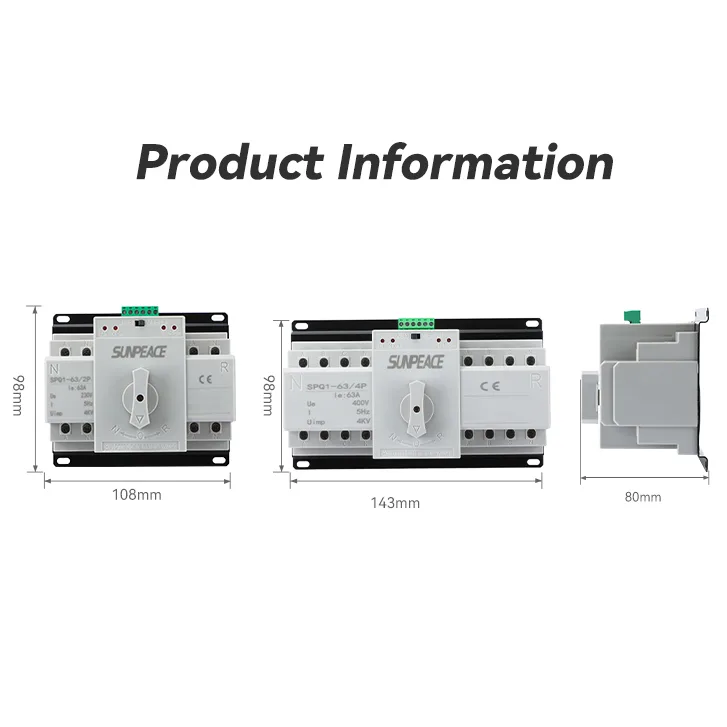
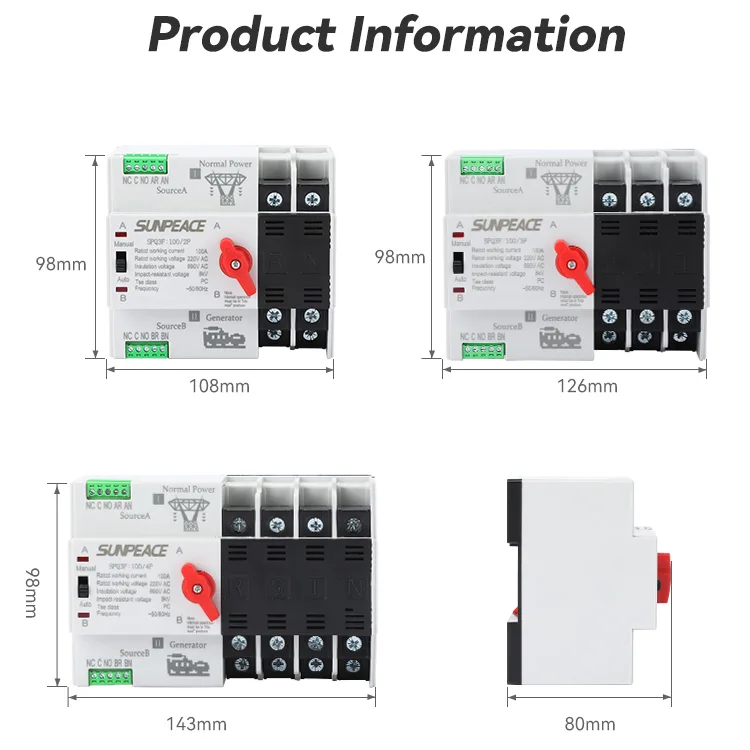
Part 5: Recommended Solution: Sunpeace Automatic Transfer Switches
For a reliable and seamless backup power solution tailored to your system’s phase, consider Sunpeace Automatic Transfer Switches. Sunpeace offers a robust range of both single-phase and three-phase ATS units, engineered for dependable performance and built to last.
Why Choose Sunpeace ATS?
- Precise Compatibility: Whether your facility runs on a residential single-phase or an industrial three-phase system, Sunpeace provides the correctly matched ATS.
- Factory-Direct Quality & Value: As a manufacturer, Sunpeace ensures high-quality construction, rigorous testing, and cost-effective pricing without distributor markups.
- Customizable Configurations: We offer flexibility to meet specific amperage, voltage, and control requirements, ensuring the ATS integrates perfectly with your generator and electrical panel.
- Expert Technical Support: Our team provides direct support to help you select, configure, and install the right transfer switch for guaranteed peace of mind.
Conclusion
Choosing between a single-phase vs three-phase system is fundamental, dictated by the scale and nature of your electrical demand. This choice then directly informs critical downstream decisions, such as selecting the appropriate Automatic Transfer Switch for backup power. By understanding the core principles of each system and the key factors in ATS selection, you can ensure not only operational efficiency but also enhanced reliability for your home or business.
Investing in the right components, like a properly specified Sunpeace ATS, is an investment in continuous operation and long-term asset protection. Assess your system’s phase and power requirements today to build a more resilient electrical infrastructure.
Contact US
Facebook:Sunpeace electric
YouTube:Sunpeace electric